


What Does Certified Porsche Oil Service Include?
Learn how Porsche oil service works, from electronic oil checks and approved synthetic oils to service intervals. Book with Autobahn Porsche Fort Worth.
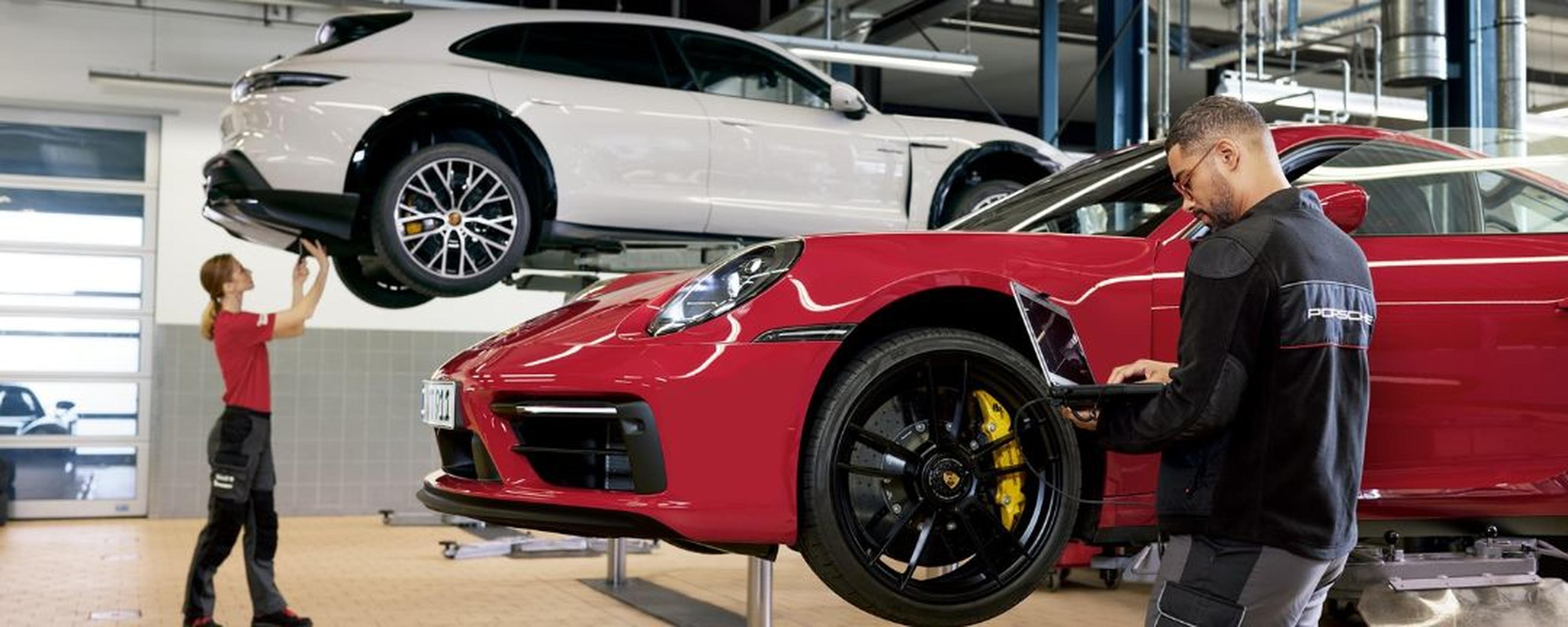
Certified Porsche oil service includes draining degraded motor oil, installing an original-equipment Porsche oil filter with a new sealing ring, refilling the crankcase with factory-approved full-synthetic oil, calibrating the electronic oil measurement system, resetting the maintenance computer, and conducting a comprehensive vehicle health check with specialized diagnostic equipment. This process ensures the powertrain operates under proper hydrodynamic lubrication, correct thermal management, and exact factory operating tolerances. Ready to have Porsche oil service done? Schedule service with our team.
Maintaining high-performance engineering requires strict adherence to manufacturer specifications. At Autobahn Porsche Fort Worth, our certified team members complete every service step to factory standards. When draining the engine, technicians inspect the old lubricant and filter media for foreign particulate, verifying the internal health of bearings, valvetrain components, and turbocharger journals. Replacing the filter housing O-rings and oil pan crush washer prevents micro-seepage under high oil-pressure conditions.
A multi-point inspection accompanies every service. Our technicians examine front radiator air ducts, underbody aerodynamic panels, brake hardware, suspension bushings, and cooling circuits. High ambient temperatures across North Texas place added strain on fluid heat exchangers and rubber seals. Catching minor wear early preserves vehicle reliability and performance on long highway drives across Aledo and surrounding communities.
Clients looking for exceptional care can reach our team by phone at (817) 663-1281, or navigate directly to our facility by following directions to our Fort Worth service center.
How Is the Engine Oil Level Checked on a Porsche Without a Traditional Dipstick?
Checking the engine oil level on a modern Porsche requires accessing the digital oil monitoring menu on the instrument cluster while the vehicle sits on level ground with the engine at normal operating temperature. Porsche models like the 911 Carrera, Cayenne, Panamera, and Macan utilize an ultrasonic pulse or capacitive sensor submerged inside the oil sump to measure fluid depth and oil dielectric properties electronically.
To obtain an accurate electronic reading, the vehicle must meet specific operational parameters:
The engine must reach full operating temperature, with oil temperature reading at least 194 degrees Fahrenheit.
The car must be parked on a completely flat, level surface.
The engine must be shut off with the ignition switched back on for roughly two to five minutes, allowing oil to drain back from cylinder heads into the lower crankcase.
Navigate via the steering wheel multifunction controls to the "Vehicle" display, scroll to the "Oil level" menu, and confirm the digital bar graph.
If the engine hood or decklid has been opened recently, the vehicle management computer suppresses the live gauge reading until the car travels approximately 10 to 15 miles under varying load conditions. This built-in logic ensures that splash aeration from fresh oil additions does not produce a false reading on the instrument cluster.
The digital display indicates fill state between minimum and maximum marks, with the distance between the two lines representing approximately one quart of lubricant. Adding oil requires measured additions—typically a quarter-quart or half-quart at a time—to avoid overfilling. Overfilling a flat-six or turbocharged V6 engine can submerge crankshaft counterweights, aerate the oil, and foul the air-oil separator or catalytic converters. Drivers needing top-off fluid or replacement components can consult our certified parts center for genuine factory fluids and seals.
Why Do Porsche Engines Require Specialized Full-Synthetic Oil and Factory Approvals?
Porsche engines require specialized full-synthetic motor oil because high specific power outputs, tight bearing clearances, and dry-sump scavenging generate intense shear forces and thermal loads that rapidly shear standard motor oils. Factory-approved oils contain shear-stable polymers and specialized anti-wear additives designed to prevent viscosity breakdown at engine speeds exceeding 7,000 rpm.
Porsche categorizes approved motor oils under specific technical standards:
Porsche A40: Formulated for high-revving gasoline engines without gasoline particulate filters, common in naturally aspirated flat-six models and pre-GPF turbocharged powertrains. Viscosities typically range in 0W-40 or 5W-40.
Porsche C30: Low-sulfated ash, phosphorus, and sulfur (low-SAPS) formulation engineered for modern turbocharged engines with advanced exhaust aftertreatment devices and particulate traps. Viscosities are predominantly 5W-30 or 0W-30.
Porsche C20: Ultra-low-viscosity lubricant, typically 0W-20, engineered for modern, highly efficient engines requiring lower hydrodynamic drag while preserving boundary-layer lubrication.
The oil capacities across the model range reflect their track-derived lubrication systems. A Macan equipped with a 2.0-liter turbocharged four-cylinder requires roughly 5.0 to 5.5 quarts of oil, whereas the 2.9-liter twin-turbocharged V6 in the Macan GTS or Cayenne demands approximately 7.5 to 8.5 quarts. Larger 4.0-liter twin-turbo V8 engines found in high-performance Cayenne Turbo trims hold up to 10 quarts. Using generic synthetic motor oil lacking the formal manufacturer certificate risks accelerated timing-chain stretch, cylinder-bore scoring, and premature turbocharger bearing degradation.
What Diagnostic Advantages Does an Authorized Porsche Service Center Provide?
An authorized Porsche service center connects your vehicle directly to the proprietary PIWIS (Porsche Integrated Workshop Information System) diagnostic network during an oil change, allowing technicians to review fault logs, calibration updates, and component adaptations. General repair facilities do not possess this direct factory link, leaving electronic modules isolated from the latest manufacturer software enhancements.
During our certified service procedure, the PIWIS interface performs an automated scan of all networked electronic control units, including engine management, transmission logic, and body electronics. This interrogation checks for open factory service campaigns, emissions recalibrations, and Technical Service Bulletins before the vehicle leaves the bay.
The specialized diagnostic platform also recalibrates the electronic oil level sensor post-service, verifying that live resistance readings match exact physical oil volumes in the pan. Technicians reset the on-board maintenance calculation algorithm, which monitors cold starts, short-trip duty cycles, and engine thermal history. This diagnostic baseline ensures that service alerts reflect actual driving conditions rather than arbitrary mileage timers.
What Are the Early Warning Signs That a Porsche Engine Requires Fresh Oil?
Early warning signs that a Porsche engine needs fresh oil include elevated operating temperatures on the oil gauge, increased valvetrain noise on cold start, a distinct dark or scorched odor from the engine compartment, and degraded idle smoothness. Monitoring these subtle changes helps owners schedule maintenance before chemical oil degradation affects vital powertrain components.
Subtle indicators of depleted oil condition include:
Elevated Oil Temperatures: As engine oil shears and absorbs combustion byproducts, its heat-transfer efficiency declines, leading to higher steady-state running temperatures on digital cluster displays during sustained highway driving.
Cold-Start Ticking: Degraded lubricant with depleted zinc and phosphorus anti-wear packages drains rapidly away from overhead camshafts and hydraulic valve lifters, resulting in a brief metallic tick upon startup until hydraulic pressure builds.
Rougher Engine Idle: Thermal breakdown increases fluid viscosity resistance and carbon accumulation around variable valve timing solenoids, creating minor micro-vibrations at idle.
Scorched Odor: Depleted thermal detergents allow minute traces of oil vapor to oxidize on high-heat turbocharger heat shields, producing a noticeable acrid smell after parking.
Addressing these warnings helps promptly prevent varnish accumulation on variable camshaft adjusters and helps maintain protective lubrication across all internal bearing surfaces.
What Service Intervals Are Included in the Porsche Scheduled Maintenance Plan?
The Porsche Scheduled Maintenance Plan structures routine vehicle maintenance into structured factory intervals scheduled every 10,000 miles or 12 months, whichever occurs first. This prepaid factory coverage ensures critical fluids, filters, and safety checks are administered on schedule by certified experts using original Porsche parts.
Factory service intervals outlined within comprehensive plans incorporate:
10,000-Mile / 1-Year Service (Minor Service): Full-synthetic engine oil and filter replacement, new drain plug seal ring, multi-point visual inspection, tire pressure and tread assessment, and diagnostic health scan.
20,000-Mile / 2-Year Service (Major Service): Engine oil and filter service, cabin pollen and dust filter replacement, brake fluid system flush, wiper blade renewal, and detailed inspection of steering, suspension, exhaust, and cooling systems.
30,000-Mile / 3-Year Service: Engine oil change and comprehensive visual diagnostics, with supplementary checks of drive belts and fluid levels across auxiliary systems.
40,000-Mile / 4-Year Service: Major powertrain evaluation including fresh engine oil, engine intake air filters, spark plug replacement on select turbocharged powertrains, and all inspection points from earlier intervals.
Adhering strictly to these maintenance checkpoints maintains factory warranty compliance, preserves vehicle resale value, and maintains precise mechanical tolerances. Drivers commuting through busy corridors in Southlake benefit from timely maintenance that prevents stop-and-go thermal stress from degrading delicate engine seals.
Porsche Oil Care: Checks, Intervals, and Service
Q: Can traditional motor oil be added to a Porsche in an emergency?
Modern Porsche engines require specific factory-approved synthetic oils. Adding non-approved conventional motor oil is strongly discouraged because conventional oils lack the thermal stability and shear strength needed to protect high-output turbocharged and high-compression components. If oil levels drop to minimum and certified lubricant is unavailable, adding a small volume of high-grade synthetic oil to reach an authorized center is acceptable, but the crankcase should be drained and refilled with approved fluid promptly.
Q: How long can a Porsche safely sit between oil services if mileage is low?
Porsche specifies that engine oil must be changed at least once every 12 months regardless of low recorded mileage. Even when a vehicle sits parked in a climate-controlled garage, motor oil absorbs ambient moisture, unburned hydrocarbons, and microscopic acids from combustion blow-by. Over twelve months, these chemical contaminants deplete the protective alkaline additives in the oil, promoting internal corrosion and moisture damage across cylinder walls and bearing surfaces.
Q: Why does the electronic oil measurement screen sometimes read "Unavailable"?
The electronic oil gauge displays an "Unavailable" status when prerequisites for measurement are not fulfilled. The vehicle must reach standard operating temperature, rest on level ground, and have its engine turned off for several minutes to allow oil drain-down. Furthermore, opening the rear decklid or front engine hood automatically resets the reading logic, requiring several miles of driving before the vehicle computer registers a stable baseline and displays the level again.
Q: What should an owner do if the instrument cluster shows a low oil warning?
When the instrument cluster indicates a low oil warning, the engine requires immediate fluid replenishment. The graphic typically specifies the recommended top-off volume, generally between 0.5 and 1.0 quart. Drivers should add the recommended quantity of Porsche-approved oil through the engine bay filler neck, wait for the sensor logic to update, and avoid aggressive acceleration until the system confirms an optimal level. If unexpected fluid loss occurs on the road, drivers with active factory warranty coverage can contact Porsche Roadside Assistance: 1-800-767-7243 for professional towing directly to an authorized dealership.
Q: Does highway driving extend the necessary Porsche oil service interval?
Highway driving is gentler on engine oil than short-trip city driving because constant engine temperatures boil off accumulated moisture and fuel vapors from the crankcase. However, sustained high-rpm cruising and Texas summer heat still shear additive chains and oxidize synthetic base stocks. Porsche engineers establish the 10,000-mile or 1-year threshold as an absolute ceiling, and adhering strictly to that maintenance window helps protect delicate turbocharger bearings and hydraulic valve lifters.
To maintain your vehicle's mechanical integrity, you can schedule your service with our certified technicians.
How Certified Porsche Oil Service Helps Preserve Sports Car Performance
Certified oil maintenance helps safeguard the responsive dynamics, linear power delivery, and acoustic precision that define Porsche engineering. Regular oil replacement using factory-specified lubricants helps prevent friction wear, protects twin turbochargers, and keeps active engine mounts and variable valve mechanisms operating without compromise.
Our dealership provides a tailored service experience centered around technical transparency, genuine components, and specialized care. For professional maintenance, visit our service department at 2815 Westside Dr, Fort Worth, TX 76107, access turn-by-turn routes via our service center map, or contact our service advisors to plan your appointment.
© 2026 Autobahn Porsche Fort Worth. All rights reserved.